Plain-language science
Amino Acids in VapoCept, Explained: Arginine, Citrulline and Beta-Alanine
Arginine and citrulline feed the nitric oxide pathway, which relaxes blood vessels. They are studied for blood pressure at 4 to 24 g and 3 to 10 g a day. Beta-alanine is studied for exercise at 4 to 6 g a day. VapoCept lists about 340 mg arginine, 200 mg citrulline and 40 mg beta-alanine. None of the studies tested memory.
What are arginine, citrulline and beta-alanine?
All three are amino acids, the small building blocks the body uses to make proteins and signal molecules. Arginine and citrulline feed the nitric oxide pathway, and beta-alanine helps muscles handle hard exercise.
They are common in sports and heart-health products, and all three appear on the VapoCept published panel. The panel lists 640 mg of amino acids per capsule across five lines.
L-Arginine
An amino acid in meat, fish, dairy, nuts and beans. The body also makes it. Blood vessel lining uses it to make nitric oxide.
L-Citrulline
An amino acid named after watermelon, one of its food sources. The kidneys turn it into arginine, so it feeds the same pathway.
Beta-Alanine
An amino acid that muscles pair with another one, histidine, to make carnosine. Carnosine helps buffer acid during hard exercise.
Your body can make arginine and citrulline on its own. Food adds more. That is why these are called "conditionally essential" or "nonessential" amino acids. Most healthy adults are not short of them.
How does the nitric oxide pathway work, in plain words?
Nitric oxide is a gas the body makes in the lining of blood vessels. It tells the vessel wall to relax, so the vessel widens and blood flows more easily.
Arginine reaches the vessel wall
Arginine from food, from the body's own supply, or from citrulline travels in the blood to the thin lining of blood vessels.
An enzyme makes nitric oxide
An enzyme in that lining splits off nitric oxide, a short-lived gas that acts as a signal. Citrulline is left over and can be recycled.
The vessel wall relaxes
Nitric oxide tells the muscle in the vessel wall to relax. The vessel widens a little, and blood flows with less push.
The signal fades fast
Nitric oxide lasts only moments, so the body keeps making more as needed. This is a normal, all-day process.
Arginine is the raw material. When you swallow arginine, a good share is broken down in the gut and liver before it reaches the blood. Citrulline mostly skips that step. The kidneys then turn it into arginine. That is why researchers study citrulline as a way to raise arginine (Allerton et al., 2018).
Brands often link nitric oxide to the brain, since the brain needs a steady blood supply. That link is an idea, not a finding for any capsule. Blood flow to the brain is tightly controlled by the body, and the studies below measured blood pressure, not memory or focus.
What are these amino acids actually studied for?
Arginine and citrulline are studied mainly for blood pressure and blood vessel function. Beta-alanine is studied for exercise. None of the studies linked here tested memory.
Arginine and blood pressure
A 2011 meta-analysis pooled trials of oral L-arginine and blood pressure. The trials used 4 to 24 g a day, with a median of 9 g. On average, blood pressure came down a little (Dong et al., 2011).
Citrulline and the heart and blood vessels
A 2018 review looked at L-citrulline and heart and metabolic health. Studies used about 3 to 10 g a day. Some found lower blood pressure or better vessel function, and results varied (Allerton et al., 2018).
Beta-alanine and exercise
The International Society of Sports Nutrition reviewed beta-alanine in 2015. It found that 4 to 6 g a day, split into smaller doses, raises carnosine in muscle and can help during short bursts of hard effort. Single doses above about 800 mg can cause a tingling of the skin (Trexler et al., 2015).
How do the VapoCept amounts compare with research doses?
Every VapoCept amount is far below the doses studies used. The capsule gives milligrams, while the studies used grams.
| Ingredient | Main research topic | Dose used in studies | VapoCept per capsule | Share of the low end |
|---|---|---|---|---|
| L-Arginine (both forms) | Blood pressure | 4 to 24 g a day, median 9 g | About 340 mg | About one twelfth of 4 g |
| L-Citrulline (both forms) | Blood pressure, vessel function | 3 to 10 g a day | 200 mg of salt forms | Under one fifteenth of 3 g |
| Beta-Alanine | Exercise performance | 4 to 6 g a day | 40 mg | About one hundredth of 4 g |
| Niacin | Daily need (not a study dose) | 16 mg NE for adult men; upper limit 35 mg | 7.5 mg NE | About half the daily need |
| Calcium | Daily need (not a study dose) | 1,000 mg a day for adults 19 to 70 | 18 mg | Under 2% of the daily need |
One plus: VapoCept has no proprietary blend. Every amount is printed on the published panel, so you can check this math yourself. Many products hide amounts inside a blend, which makes this kind of table impossible.
How the arginine adds up
The panel lists 200 mg of L-arginine base and 200 mg of L-arginine AKG 2:1. AKG stands for alpha-ketoglutarate, a compound cells use when they make energy. A 2:1 ratio means about two parts arginine to one part AKG. So the AKG line adds about 140 mg of arginine, for about 340 mg in total.
That is about one twelfth of the 4 g low end in the blood pressure trials, and about one twenty-sixth of the 9 g median.
How the citrulline adds up
The panel lists 100 mg of L-citrulline HCl and 100 mg of L-citrulline malate. Both are salt forms, where citrulline is bound to another compound. So the 200 mg total holds slightly less pure citrulline. Even as a full 200 mg, it is one fifteenth of the 3 g low end.
How the beta-alanine adds up
The panel lists 40 mg. That is one hundredth of the 4 g low end in exercise studies. It is also far below the roughly 800 mg single dose linked to tingling, so tingling is unlikely.
What do the niacin and calcium lines add?
Niacin and calcium are a vitamin and a mineral, not amino acids. In VapoCept they come in small amounts that count toward your daily total.
Niacin, also called vitamin B3, helps the body turn food into energy. The capsule lists 7.5 mg NE. Adult men need 16 mg NE a day, and the upper limit from supplements is 35 mg (NIH ODS, niacin). A multivitamin often adds more, so add the two together.
Calcium builds bones and teeth. The capsule lists 18 mg. Adults 19 to 70 need 1,000 mg a day (NIH ODS, calcium). So 18 mg is a very small share.
Who should talk to a doctor before taking these amino acids?
Anyone on blood pressure medicine, or with a heart, kidney or blood pressure condition, should ask a doctor first. Arginine and citrulline can lower blood pressure.
VapoCept is for adults 18 and over. If you are pregnant or nursing, talk to your doctor first. The side effects page covers the details.
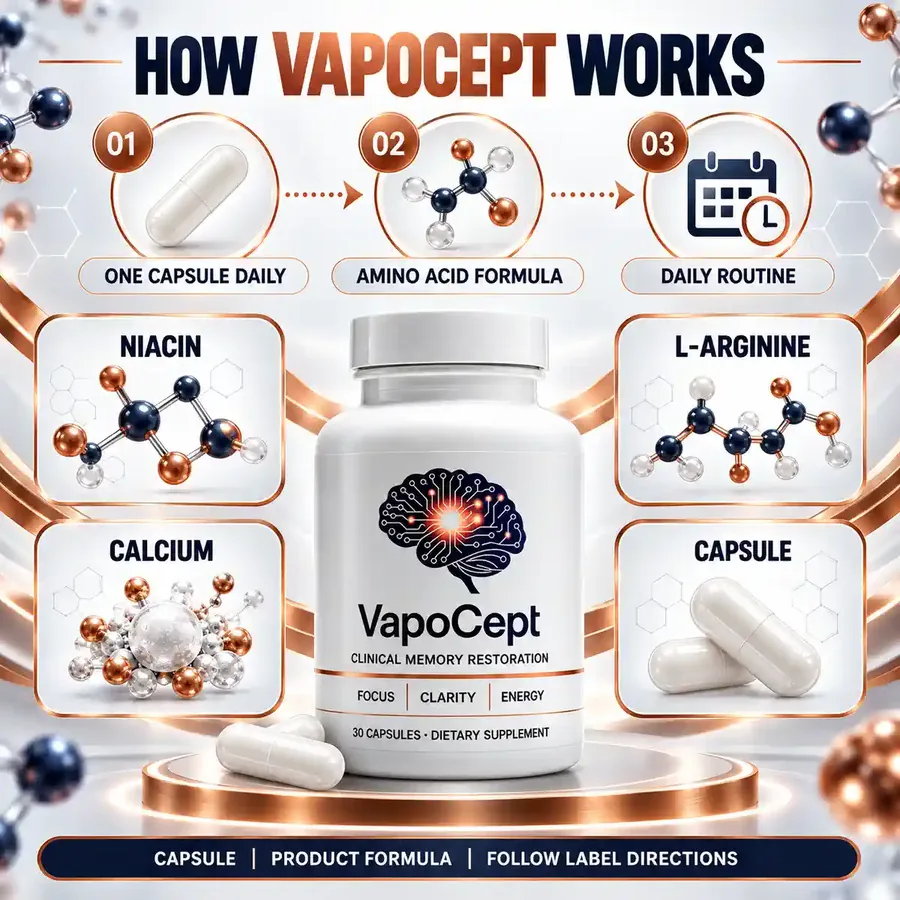
To see the amounts line by line, open the Supplement Facts page. For each ingredient on its own card, see the ingredients page. For habits that support focus without a capsule, read the everyday brain health guide.
Amino acids in VapoCept: common questions
Are arginine and citrulline studied for memory?
The studies linked here looked at blood pressure and blood vessel function, not memory. NCCIH says evidence for supplements and cognitive function is generally weak.
Why does VapoCept include both arginine and citrulline?
Both feed the nitric oxide pathway. Citrulline is turned into arginine by the kidneys and is less broken down in the gut. The brand does not explain its choice.
How much arginine is in one VapoCept capsule?
About 340 mg: 200 mg of arginine base plus about 140 mg from the 200 mg of arginine AKG 2:1.
Will the beta-alanine in VapoCept cause tingling?
Unlikely. Tingling is linked to single doses above about 800 mg, and the capsule lists 40 mg.
Can I get these amino acids from food?
Yes. Meat, fish, dairy, nuts and beans supply arginine, and watermelon supplies citrulline. The body also makes both.
Is it safe to take more capsules to reach research doses?
No. Follow the label: one capsule daily. Extra capsules would also add niacin, and doses in the grams belong in a talk with your doctor.
Sources for this page
- Dong JY, Qin LQ, Zhang Z, et al. Effect of oral L-arginine supplementation on blood pressure: a meta-analysis of randomized, double-blind, placebo-controlled trials. Am Heart J, 2011. Source
- Allerton TD, Proctor DN, Stephens JM, Dugas TR, Spielmann G, Irving BA. L-Citrulline supplementation: impact on cardiometabolic health. Nutrients, 2018. Source
- Trexler ET, Smith-Ryan AE, Stout JR, et al. International society of sports nutrition position stand: Beta-Alanine. J Int Soc Sports Nutr, 2015. Source
- National Center for Complementary and Integrative Health. Dietary Supplements and Cognitive Function, Dementia, and Alzheimer's Disease: What the Science Says. Source
- NIH Office of Dietary Supplements. Niacin: Fact Sheet for Consumers. Source
- NIH Office of Dietary Supplements. Calcium: Fact Sheet for Consumers. Updated September 2023. Source
Keep reading
Ready when you are
Order VapoCept from the authorized US retailer
30 capsules in every bottle, 1 capsule a day. 60-day money-back guarantee. A real person at +1 (507) 448-8190 for orders, tracking and refunds.